
A first veena class is less about completing a song and more about learning how the instrument sits, sounds and responds to your hands. You will see what to bring, what the teacher checks, how early Carnatic exercises are organised, and how to judge whether a class suits your learning needs.
Key takeaways
- Expect an introduction, posture check and your first guided sound.
- Learn plucking, finger placement and tuning before attempting a full composition.
- Track progress through cleaner notes, steadier tala, better posture and new repertoire.
- Compare online and in-person classes by feedback quality, practice space and schedule.
Your First Veena Lesson: From Introduction to the First Sound
The first 10–15 minutes usually establish how the lesson will be taught, not a performance. The teacher asks about your age, musical background, hand comfort, sense of rhythm, goals and preferred language.
You might discuss whether you want Carnatic foundations, devotional songs or another outcome, and whether explanations in English, Kannada, Telugu or Tamil will be easiest to follow.
Next, the teacher inspects the veena, checking its tuning, strings, frets and physical condition. If you own one, bring it; otherwise, confirm in advance whether the school supplies an instrument for the first class. This practical check is a key part of what happens in veena classes in bengaluru.
You are shown how to sit with the kudam resting securely against your left thigh and the body supported comfortably. The dandi is stabilised so it does not wobble, while the right hand rests near the bridge and the left hand can move without wrist strain.
The teacher then demonstrates a slow open-string plucking exercise, correcting accidental contact with adjacent strings and listening for a clear tone.
Bring these items:
- Your veena, if you own one
- A notebook for swaras, posture notes and practice instructions
- A recording device, if the teacher permits recording
- Willingness to sing or say the swaras aloud
Veena classes beginners in bengaluru do not usually begin with a kriti. You first learn to produce a steady sound and follow the teacher’s instructions before tackling repertoire.
Learning the Veena’s Parts and Holding It Correctly
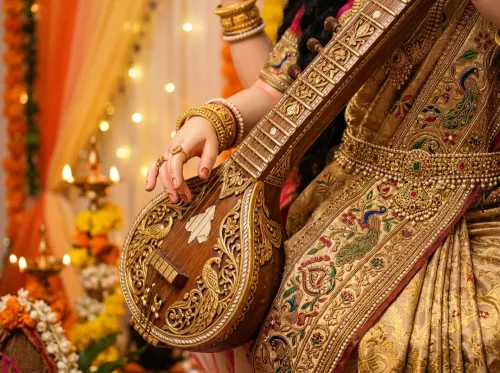
A beginner first learns the veena’s physical map, because confusion about parts leads to poor hand placement. The kudam is the large resonating body; rest it securely against the left thigh and lightly against your body.
The dandi, or neck, extends forward at a comfortable upward angle, with the meru, or frets, forming the reference points beneath the left hand.
| Part | Position | Beginner’s purpose |
|---|---|---|
| Kudam | Against the left thigh and body | Supports the instrument |
| Dandi | Angled forward and slightly upward | Keeps the fretboard accessible |
| Meru or frets | Along the dandi | Mark fixed pitch positions |
| Sarani strings | Main playing strings | Carry the melodic notes |
| Three side or tala strings | Along the instrument’s side | Provide rhythmic support |
| Dragon-head yali | At the far end | Identifies the carved terminal section |
| Tuning pegs | Near the string ends | Adjust string pitch |
Your right hand rests near the bridge, where short, controlled plucks produce a clear tone. Your left hand moves along the fretboard without gripping; the teacher checks that you can reach nearby frets without a bent or strained wrist and that the dandi stays stable while you shift.
This setup matters before speed, repertoire or elaborate ornamentation. A poor angle creates wrist pain, a moving neck causes missed frets, and tense plucking hides pitch problems. That is why veena classes beginners in bengaluru should prioritise comfort, while carnatic veena training in bengaluru should make posture part of every correction.
The First Technical Skills: Plucking, Finger Placement and Tuning
1. Both hands begin with one clean note at a time. The right hand plucks a selected string with a mizhrab where that method is used, or with the fingernail, keeping the finger from catching adjacent strings and adjusting its position near the bridge until the tone rings clearly.
2. The left hand places a fingertip just behind the fret, then applies only enough pressure to stop the string. Too much force creates strain; too little causes buzzing. You practise basic string changes and plain notes before raga-specific gamaka, because an unplanned slide or oscillation can distort the raga phrase.
3. Tuning starts with the tonic, or shruti, and the four main playing strings. You learn to identify the sarani string, locate the tuning pegs, and check whether each string matches the reference pitch. The three side strings support tala or add rhythmic emphasis rather than carrying the main melody.
4. Your teacher will help diagnose a shifted pitch, buzzing from fret contact, or a string that goes out of tune after the veena moves. Learning to hear and check tuning is different from tuning independently; the latter requires coordinated peg adjustments and repeated pitch checks.
This practical sequence is central to Carnatic veena training in Bengaluru and gives a clear veena lesson structure in Bengaluru before speed or ornamentation.
How Beginner Lessons Build Technique, Tala and Repertoire
After the first class, a common progression moves from clean note order to coordinated patterns, tala control and simple repertoire, without imposing a fixed syllabus.
1. Sarali varisai establishes sa, ri, ga, ma, pa, da and ni in order while the left hand finds frets and the right hand plucks evenly. Teachers may use Mayamalavagowla-based exercises, another exercise set or a short devotional melody.
2. Janta varisai repeats notes, building controlled plucking and consistent finger pressure. Rushing here creates uneven tone and makes later phrases difficult.
3. Dhattu varisai introduces skips between notes, testing whether you can move across frets without losing pitch or hand coordination.
4. Alankaram places patterns across tala cycles. You may count Adi tala as an eight-beat cycle, using hand gestures—clap, little-finger count, ring-finger count, middle-finger count—while matching each pluck to sa, ri, ga, ma, pa, da and ni.
5. A simple geetham usually comes before demanding swara passages, raga-based work, varnam or kriti. This lets you combine notes, plucking and tala without ornamentation overwhelming technique.
A typical 30- to 60-minute veena lesson structure in Bengaluru includes review, correction of posture, pitch or plucking, one small new phrase and assigned home practice. Carnatic veena training in Bengaluru can follow this pattern while changing the pace for each learner; a familiar melody alone does not prove that technique is being taught systematically.
Choosing a Class Format and Knowing Whether You Are Progressing
In-person lessons are the easier choice for correcting the veena’s angle, left-hand pressure, plucking path and tone in real time. Online lessons work when the camera shows both hands and enough of the fretboard; audio compression can conceal subtle gamaka and tone problems.
| Format | What you can compare | What to check |
|---|---|---|
| In person | Immediate posture, hand and sound correction | Instrument access and travel time |
| Online | Flexible attendance and a repeatable camera setup | Camera angle, microphone quality and feedback between lessons |
Between classes, expect a short practice plan rather than a new song every week. Progress means keeping steady tala, changing strings cleanly, producing acceptable shruti, repeating an exercise in more than one speed and reproducing accurate short phrases. Counting completed songs is a poor measure if the notes remain uneven.
Ask each teacher:
- Is a veena supplied, or must you bring one?
- What teaching language do you use?
- How long is each lesson?
- How do you give homework feedback?
- What happens if you miss a class?
- Do you expect singing or vocalising swaras?
This is the practical test for what happens in veena classes in Bengaluru and for comparing the veena lesson structure in Bengaluru. Sri Veena Vani Music School is one Bengaluru option to evaluate against these details, not a substitute for checking whether the teaching fit suits you.
Related product
Veena Classes ₹3000 Sri Veena Vani Music School in Bengaluru, India, offers professional and structured veena classes for learners of all ages. View product → |
Frequently asked questions
What happens in a first veena lesson in Bengaluru?
The teacher discusses your background, goals, hand comfort, rhythm and preferred language, then introduces the instrument and guides you through producing your first sound.
What do beginners learn first in veena classes?
Beginners learn the veena’s parts, correct posture, plucking technique, finger placement and basic tuning before moving into structured exercises.
How do Carnatic veena lessons build technique and repertoire?
Lessons combine technical exercises with tala practice and progressively introduce Carnatic pieces as your plucking, fingering, rhythm and posture improve.
How can you tell whether you are progressing in veena classes?
Look for cleaner notes, steadier tala, more comfortable posture, improved tuning and the ability to play increasingly difficult exercises or compositions.
Keywords